



| Quantity: | |
|---|---|


1045
Qilu
Product Description
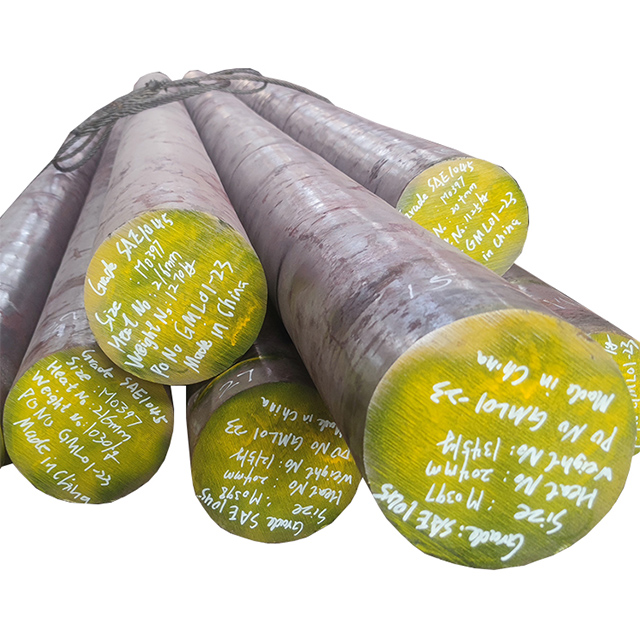
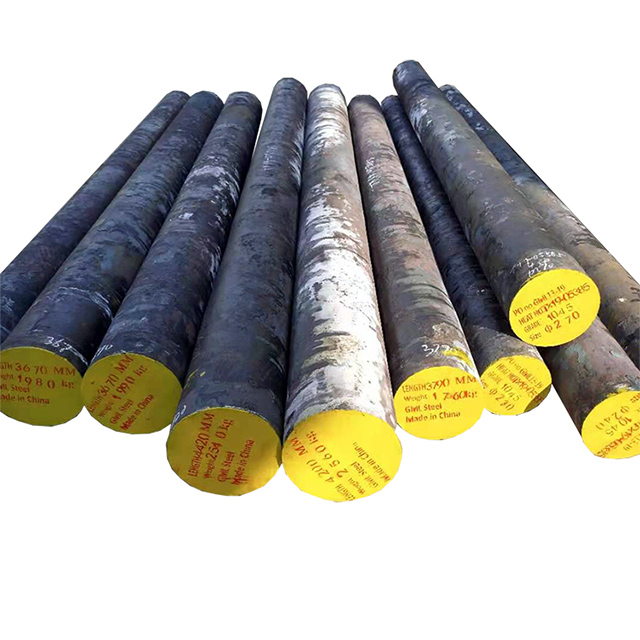
Hot rolled and forged medium carbon steel round bar, supplied as-rolled, annealed or quenched & tempered to 28–34 HRC, 16 mm to 400 mm diameter, with rough machining done in our own workshop.
Equivalent to: AISI / SAE 1045 (ASTM A29) · DIN C45 / 1.0503 (EN 10083-2) · JIS S45C (G4051) · BS 080A47 / En43 · GB 45# (GB/T 699)
ASTM A20 AISI 1045 Carbon Steel Bar
ASTM A20 AISI 1045 Carbon Steel Bar
ASTM A20 AISI 1045 Carbon Steel Bar
Supply form — Round bar, also available as bright drawn and peeled
Process — Hot rolled / forged, cold drawn on request
Condition — As-rolled, annealed, or QT to 28–34 HRC
Diameter range — 16–400 mm (hot rolled); 6–80 mm (cold drawn)
Melting route — EAF + LF
Standard — ASTM A29, DIN EN 10083-2, JIS G4051, GB/T 699
Certificate — EN 10204 3.1 standard, 3.2 on request
Lead time — 12–25 days
1045 is a medium carbon steel specified in ASTM A29. With about 0.45 % carbon and no significant alloying additions, it sits at the upper end of the plain carbon range — strong enough for shafts and gears that carry moderate loads, but cheaper and easier to machine than the Cr-Mo alloy grades. It does not through-harden in large sections: above roughly 75 mm diameter the core stays soft even after oil quenching, which is why big shafts move to AISI 4140.
| Element | AISI 1045 (%) | DIN C45 / 1.0503 (%) | JIS S45C (%) | GB 45# (%) |
|---|---|---|---|---|
| Carbon (C) | 0.43 – 0.50 | 0.42 – 0.50 | 0.42 – 0.48 | 0.42 – 0.50 |
| Manganese (Mn) | 0.60 – 0.90 | 0.50 – 0.80 | 0.60 – 0.90 | 0.50 – 0.80 |
| Silicon (Si) | — | ≤ 0.40 | 0.15 – 0.35 | 0.17 – 0.37 |
| Phosphorus (P) ≤ | 0.030 | 0.030 | 0.030 | 0.035 |
| Sulfur (S) ≤ | 0.050 | 0.035 | 0.035 | 0.035 |
In the as-rolled condition 1045 typically reaches 565–625 MPa tensile. Quench and temper lifts that to 700–850 MPa with good ductility in the tempered range. Values below are typical for medium sections; mechanical properties drop noticeably above 75 mm because hardenability is limited by the lack of alloying elements — that is a metallurgical limit, not a heat-treatment problem.
| Condition | Hardness | Rm (MPa) | Re (MPa) | A5 (%) |
|---|---|---|---|---|
| As-rolled | 170 – 210 HB | 565 – 625 | 300 – 360 | 12 – 16 |
| Annealed | ≤ 197 HB | ~ 540 | ~ 290 | ~ 18 |
| QT (28–34 HRC) | 28 – 34 HRC | 700 – 850 | 500 – 600 | 10 – 14 |
| Standard | Designation | Material No. |
|---|---|---|
| ASTM A29 (US) | 1045 / G10450 | — |
| DIN EN 10083-2 (EU) | C45 | 1.0503 |
| JIS G4051 (JP) | S45C | — |
| BS 970 (UK) | 080A47 / En43 | — |
| GB/T 699 (CN) | 45# | — |
Shafts and spindles — general-purpose shafts, gear shafts, motor shafts in light to medium duty
Gears and pinions — spur gears, bevel gears where loads are moderate and size is small
Fasteners — high-strength bolts, studs and nuts that need more strength than low-carbon grades
Machinery parts — axles, crankshafts, guide rods, guide pins and machine components
For parts that need strength above the as-rolled level, 1045 is oil quenched from 820–860 °C and tempered between 400–600 °C. Water quenching gives higher surface hardness but cracks more readily in sections above about 25 mm, so oil is the default for shafts. If your drawing specifies a target hardness range, tell us the working diameter — through-hardness drops off sharply in larger sections and we can advise whether 1045 is the right grade or you should move to 4140.
Most suppliers in this business are traders who subcontract everything. We run our own processes, which means shorter cycles and one point of accountability when something needs fixing.
Heat treatment shop — quenching and tempering to your target hardness, with furnace charts recorded per batch
Machining shop — rough turning, peeling and cutting to length, so your bar arrives ready for finish machining
Testing — ultrasonic per ASTM A388 / EN 10228-3, hardness mapping across the section, tensile and impact testing
Certification — EN 10204 3.1 as standard, 3.2 available with third-party witness (ABS, BV, CCS, GL)
Export packing — bundled, end-capped and rust-protected for sea freight
1045 is a plain carbon steel with no alloying elements; 4140 adds about 1 % chromium and 0.2 % molybdenum. That gives 4140 much better hardenability, so it through-hardens in large sections where 1045 stays soft at the core. For shafts above about 75 mm diameter, or for parts under cyclic impact loads, 4140 is the safer choice. For small parts under steady load, 1045 is cheaper and machines better. See our AISI 4140 alloy steel round bar page for the full comparison.
Yes. We heat treat in our own shop and verify hardness across the section. Tell us the required hardness range and the working diameter, because the achievable core hardness in 1045 depends strongly on section size.
S45C is the JIS G4051 designation for the same grade as AISI 1045 / C45. It is the most common name on stock lists in Asia and is widely used on drawings from Japan, Korea and Taiwan. Composition ranges are essentially identical, so 1045, C45 and S45C are interchangeable in practice for most applications.
For standard sizes held in stock we accept trial quantities. For forged-to-order sizes the MOQ depends on the melting batch — contact us with your specification and we will confirm.
Send us your diameter, length, quantity, required hardness and destination port. You will get a quotation with the full technical proposal within 24 hours.
Email: enquiry@qilumetal.com | Web: www.qilumetal.com


