





Q235D/ S235J2
Qilu
Product Description
Hot forged and rolled Q235D / S235J2 (1.0117) round bar from 20 mm to 300 mm, certified with 27 J Charpy at −20 °C and supplied with EN 10204 3.1 documents. The low-temperature end of the 235 MPa structural class — ordered as Q235D to GB/T 700-2006 for Chinese mill supply and as S235J2 to EN 10025-2 for European projects, both tested at the same −20 °C temperature.
Equivalent to: EN 10025-2 S235J2 (1.0117) · GB/T 700-2006 Q235D · old DIN St37 class (lower temperature variant) · ASTM A36 class (static duty, no base impact requirement)
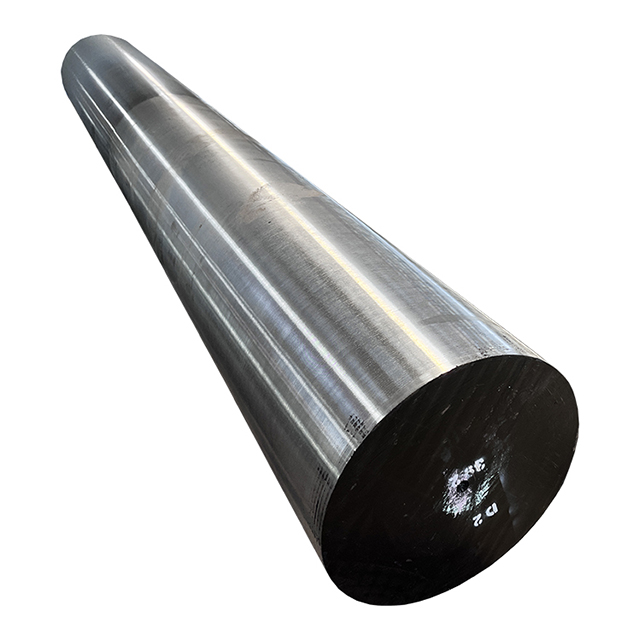
Q235D / S235J2 forged round bar, as-forged surface
Product form: hot forged bar, hot rolled bar; peeled and ground bar on request
Diameter range: 20 mm – 300 mm; lengths 3–6 m or cut to size
Delivery condition: as-rolled / as-forged (+AR) or normalized (+N)
Production route: EAF or BOF melting, secondary refining, forging or hot rolling
Standards: GB/T 700-2006 (Q235D), EN 10025-2 (S235J2)
Certificates: EN 10204 3.1 with heat analysis, tensile and Charpy results; 3.2 by agreement
Testing: tensile per heat; Charpy 27 J at −20 °C per the D / J2 suffix; UT by agreement
Lead time: stock sizes ex-warehouse; forged diameters typically 20–35 days
Q235D and S235J2 are the coldest-tested members of the 235 MPa family. Both keep carbon at or below 0.17 % — the whole S235 class does, which is what makes it so weldable — and the low-temperature suffix is bought with cleaner steel: phosphorus and sulfur pulled down to 0.025 % in S235J2 (0.030/0.035 in the JR grade) and a fully killed deoxidation practice. The table shows the elements that decide the substitution question; silicon, copper and nitrogen limits follow each standard's own table.
| Element (heat analysis, max unless noted) | C | Mn | P | S |
|---|---|---|---|---|
| EN 10025-2 S235J2 (1.0117) | 0.17 % | 1.40 % | 0.025 % | 0.025 % |
| GB/T 700-2006 Q235D | 0.17 % | per GB/T 700-2006 Table 1 | 0.035 % | 0.035 % |
| EN 10025-2 S235JR (for comparison) | 0.17 % | 1.40 % | 0.035 % | 0.035 % |
The pattern to notice: within the S235 class, the move from JR to J2 does not change the carbon ceiling — it tightens phosphorus and sulfur and requires fully killed steel. That is also why shipping a JR-grade bar against a Q235D / S235J2 order is not a negotiation point: the certificate would have to show the tighter P and S values, and a heat made to the JR ceiling may not be there. Where the application climbs in strength, the next step up in this family is the S355JR / Q355B round bar page.
Both specifications headline 235 MPa minimum yield for small sections, stepping down as thickness grows. The tensile band is deliberately wide — this is a structural steel meant to bend and weld predictably, not a machine steel meant to hit a hardness number.
| Property | S235J2 (EN 10025-2) | Q235D (GB/T 700-2006) |
|---|---|---|
| Yield, ReH (≤16 mm) | 235 MPa min | 235 MPa min (ReL) |
| Tensile, Rm (≤100 mm) | 360–510 MPa | 370–500 MPa |
| Charpy V-notch | 27 J at −20 °C (longitudinal) | 27 J at −20 °C |
| Higher suffixes | Yield steps down with thickness per EN 10025-2 | Same pattern per GB/T 700-2006 |
Elongation minimums depend on thickness and product form in both standards and are reported per heat on the certificate. Hardness is not a specified property for either grade — if a drawing carries an HRC requirement, it belongs on a heat-treatable grade, not here.
| Standard | Grade | Material No. / Notes |
|---|---|---|
| GB/T 700-2006 (China) | Q235D | D suffix: 27 J at −20 °C; B/C test at +20 °C / 0 °C |
| EN 10025-2 (Europe) | S235J2 | 1.0117; S235JR (1.0038) is the +20 °C sibling |
| Old DIN 17100 (withdrawn) | St37 class | St37-2 corresponds to S235JR, not the J2 variant |
| ASTM A36/A36M (USA) | A36 (class) | 250 MPa yield, no Charpy in base specification |
| JIS G3101 (Japan) | SS400 (class) | 245 MPa yield, no guaranteed impact data |
The recurring trap in this row of the table: A36, SS400 and Q235B all get called "equivalent to S235" in day-to-day quoting, and all three lack the −20 °C impact test that the D / J2 suffix exists to guarantee. For cold-climate or outdoor-at-height service, the suffix is the specification — everything else in the row is just the strength class. Cross-standard comparisons for the 355 MPa class are covered in our S355 vs Q355 vs A572 article, and the same substitution logic applies one class down.
Structural pins, base plates and fittings for equipment operating outdoors in winter conditions
Welded frames, brackets and supports where the design code asks for −20 °C toughness
Construction hardware: anchor bolts stock, stay rods, tie rods and lugs
Light-duty shafts and spacers where formability and weldability outrank strength
General fabrication stock for export machinery built to GB or EN design codes
Where it is the wrong answer: any duty with meaningful fatigue, torque or wear. This class is chosen for what it costs and how it welds; when a drawing starts specifying hardness or case depth, the conversation moves to alloy or tool steel, and the earlier that happens the cheaper the project is.
Forging versus rolling. Forged rounds carry a denser, more uniform structure across large diameters, which matters for upset-heavy fittings and for sections above roughly 100 mm; rolled bar is the economical route for the common mid-range sizes. Both delivery states meet the same mechanical table, and the choice usually comes down to diameter and the buyer's downstream process. Forged or rolled, the low-temperature Charpy requirement is tested per heat regardless.
Welding. With carbon held at or below 0.17 %, this is about as weldable as structural steel gets: no preheat on thin sections, ordinary consumables per the fabricator's procedure, and none of the hardenability concerns that follow higher-carbon or alloyed grades. The same low carbon is also why the grade will not respond to quench-and-temper — case hardening and through-hardening are simply not on this steel's menu.
Surface and tolerance. As-forged surface carries scale and occasional laps that need machining stock; peeled bar removes both and arrives ready for the machine shop. How to write condition and tolerance class (h9 / h11) on the order line is covered in our bar condition and tolerance guide.
Hot forging and rolling from 20 mm to 300 mm with in-house normalizing
Charpy testing at −20 °C per heat — the test the D / J2 suffix stands on
Peeling, grinding and cut-to-length for machine-ready bar
EN 10204 3.1 certificates with heat analysis, tensile and impact results
UT to EN 10160 or ASTM A388 by agreement for orders that carry volumetric requirements
ISO 9001 certified; ABS / BV / CCS / DNV survey experience
Export packing with heat-number traceability kept through bundling and shipment
The suffix is the test temperature: Q235B is certified at +20 °C, Q235C at 0 °C, Q235D at −20 °C, each requiring 27 J. The chemistry tightens as the suffix goes down — Q235D carries the lowest carbon, phosphorus and sulfur ceilings of the family. If the structure sees winter, order the D and let the certificate prove it.
In the static, above-freezing sense, roughly — both are ~235–250 MPa structural steels. But S235J2 brings a −20 °C impact guarantee and tighter P/S limits that A36's base specification never asks for, so the substitution direction matters. S235J2 against an A36 callout over-satisfies the specification; A36 against a J2 order fails the impact requirement, full stop.
Rolling reduction thins out at large sections, and the as-rolled core can lag the surface in soundness and uniformity. Forging works the whole cross-section, giving a more consistent structure — which matters when the bar will be upset, bored, or UT-scanned against a tight acceptance class.
Yes. The 3.1 certificate lists the Charpy energy, the test temperature and the specimen orientation alongside the heat analysis and tensile results, traceable to the heat number marked on the bar. If your inspector wants UT results or a 3.2, say so at enquiry and we build it into the order.
Send diameter, length, condition (as-forged / +N / peeled), governing standard (GB/T 700 Q235D or EN 10025-2 S235J2) and quantity to enquiry@qilumetal.com. We quote Q235D / S235J2 round bar with EN 10204 3.1 certificates, −20 °C impact testing per heat, and in-house forging and normalizing.


