

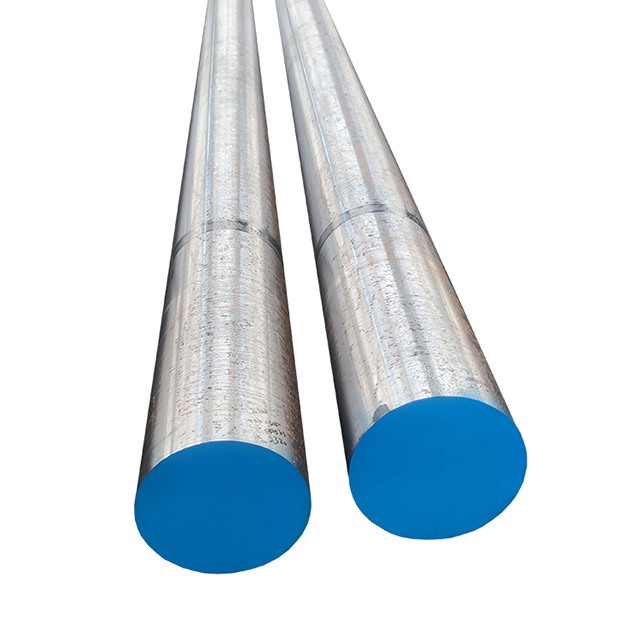


DIN S355JR/GB Q355B
Qilu
Product Description
Hot rolled and forged S355JR (1.0045) / Q355B round bar from 16 mm to 300 mm, supplied as-rolled (+AR) or normalized (+N) with EN 10204 3.1 certificate. The default 355 MPa structural grade for welded frames, machinery bases, brackets and light-duty shafts — ordered to EN 10025-2 for European projects and to GB/T 1591-2018 for Chinese mill supply, with chemistry and impact data reported per heat.
Equivalent to: EN 10025-2 S355JR (1.0045) · old DIN 17100 St52-3 class · GB/T 1591-2018 Q355B · ASTM A572 Gr 50 class (static duty, no base impact requirement)
S355JR / Q355B hot rolled round bar, as-rolled surface
Product form: hot rolled bar, forged bar, peeled bar; cut-to-length on request
Diameter range: 16 mm – 300 mm; lengths 3–6 m or cut to size
Delivery condition: as-rolled (+AR) or normalized (+N), both standard routes under EN 10025-2
Production route: EAF or BOF melting, secondary refining, hot rolling or forging
Standards: EN 10025-2 (S355JR), GB/T 1591-2018 (Q355B); JIS G3101 SS400 sits a class below
Certificates: EN 10204 3.1 with heat analysis, tensile and Charpy results; 3.2 by agreement
Testing: tensile and impact per heat; UT to EN 10160 / ASTM A388 when the order calls for it
Lead time: stock sizes ex-warehouse; forged diameters typically 20–35 days
S355JR is a plain carbon-manganese structural steel with no deliberate alloying beyond Mn. The strength comes from the ferrite-pearlite structure of a 0.20–0.24 % carbon, 1.60 % manganese steel — there is no quench-and-temper step to control, which is precisely why the grade fabricates and welds the way fabricators expect. Residual copper is capped because the grade is often supplied from scrap-based EAF melts, and copper is the element that causes surface cracking during hot working when it accumulates.
| Element (heat analysis, max unless noted) | C | Si | Mn | P | S | Cu |
|---|---|---|---|---|---|---|
| EN 10025-2 S355JR (1.0045) | 0.24 % | 0.55 % | 1.60 % | 0.035 % | 0.035 % | 0.55 % |
| GB/T 1591-2018 Q355B | 0.20 % | per GB/T 1591-2018 Table 1 | per GB/T 1591-2018 Table 1 | 0.035 % | 0.035 % | per GB/T 1591-2018 Table 1 |
The carbon gap is the headline: Q355B is held to 0.20 % against the JR ceiling of 0.24 %, which is one reason the GB grade can afford a stricter impact requirement (34 J against 27 J). The full silicon, manganese and microalloy windows for Q355 differ from EN and belong to GB/T 1591-2018 Table 1 — we match the certificate against the drawing's governing standard instead of assuming a two-way swap. For low-temperature duty the same family continues as S355J2 / ST52-3N round bar, certified at −20 °C.
The values below are the base-specification figures for small sections. Yield steps down as diameter grows — this is a rolling-dependent property, not a heat-treatment one — so always read the row that matches the actual bar size.
| Property | S355JR (EN 10025-2) | Q355B (GB/T 1591-2018) |
|---|---|---|
| Yield, ReH (≤16 mm) | 355 MPa min | 355 MPa min (ReL) |
| Yield, thicker sections | 335 MPa (16–40 mm), lower beyond | 335 MPa (16–40 mm), lower beyond |
| Tensile, Rm (≤100 mm) | 470–630 MPa | 470–630 MPa |
| Charpy V-notch | 27 J at +20 °C (longitudinal) | 34 J at +20 °C |
| Elongation | Thickness and product-form dependent, per EN 10025-2 | Per GB/T 1591-2018 |
Two notes we make on every quotation in this grade. First, the yield figure scales down with section: a Ø200 forged round will not certify 355 MPa, and a drawing written against thin-plate values must be re-checked before the order. Second, hardness is not a specified property for this grade — any HRC requirement belongs on a different steel, typically a quenched-and-tempered alloy such as 4140 / 42CrMo4 round bar.
| Standard | Grade | Material No. / Notes |
|---|---|---|
| EN 10025-2 (Europe) | S355JR | 1.0045 |
| Old DIN 17100 (Germany, withdrawn) | St52-3 class | St52-3U ≈ J0, St52-3N ≈ J2; JR is the as-rolled sibling |
| GB/T 1591-2018 (China) | Q355B | Successor to Q345B after the 2018 revision |
| ASTM (USA) | A572 Gr 50 (class) | 345 MPa yield, no Charpy in base specification |
| JIS G3101 (Japan) | SS400 (class, lower) | 245 MPa yield, no guaranteed chemistry beyond P/S |
"Equivalent" in this table means the strength class lines up — not that certificates are interchangeable. The detailed mapping, including the impact-temperature asymmetry between the EN letter suffixes and the GB letters, is covered in our article on S355 vs Q355 vs A572 Grade 50. The short version for ordering: name the governing standard and the suffix on the purchase order, and let the certificate follow that standard.
Welded frames, machinery bases, bedplates and support structures
Bridge and building components where EN 1090 execution applies
Light-duty shafts, pins, tie rods and stay bolts in static or slowly cycling service
Base flanges, anchor rods and fittings for towers and masts
General fabrication stock for export machinery built to EN design codes
Where S355JR is the wrong answer: rotating shafts with meaningful torque and fatigue duty belong on a quenched-and-tempered alloy steel, and wear surfaces belong on a through-hardening or carburising grade. Structural steel earns its keep by being weldable, predictable and cheap per tonne — not by pretending to be a machine steel.
As-rolled (+AR) is the default: the bar leaves the mill in its rolling state, meets the full mechanical table, and costs the least. Normalized (+N) adds a furnace pass that evens out grain size across the section — worth ordering on larger forged diameters where the as-rolled core can lag the surface, and mandatory when the drawing says so. Neither route is a quench; there is no martensite in this grade's delivery state.
Welding. Fabricators care about the carbon equivalent more than the yield number. EN 10025-2 uses the IIW formula CEV = C + Mn/6 + (Cr+Mo+V)/5 + (Ni+Cu)/15 with per-grade maximums in its annex, and two heats both "in spec" can differ noticeably in CEV. Our standing advice: have CEV reported on the 3.1 certificate, especially if a welding procedure has already been qualified — re-qualification discovered mid-project is a schedule killer, not a metallurgy problem. Preheat requirements are mild for thin sections and grow with combined thickness and CEV, per the fabricator's welding procedure.
Machining. As-rolled S355JR cuts at low speeds with carbide tooling and produces stringy chips; the peeled (+peeled) surface condition removes mill scale and decarburized skin before machining and is the economical choice when the buyer would otherwise face a heavy first cut. Tolerance class and surface finish belong on the order line — our guide to bar condition and tolerance classes covers how to write it.
Hot rolling and forging from 16 mm to 300 mm with in-house normalizing furnaces
Peeling, grinding and cut-to-length so bar arrives ready for the machine shop
Tensile and Charpy testing per heat, reported on EN 10204 3.1 certificates
CEV reporting on certificates by agreement — the line welders actually read
UT to EN 10160 or ASTM A388 for orders that carry volumetric requirements
ISO 9001 certified; ABS / BV / CCS / DNV survey experience for marine and structural work
Export packing with heat-number traceability maintained through bundling and shipment
Usually yes for non-CE work — the mechanical envelope is identical in thin sections and the GB impact requirement is actually stricter. The two open items are certificate format (EN 10204 3.1 in the EN system) and the CEV annex the welding engineer references. We flag both on the order rather than assuming them away; for CE-marked fabrication, get the designer's sign-off first.
Test temperature. JR certifies 27 J at +20 °C; J2 certifies 27 J at −20 °C and carries a tighter carbon ceiling (0.20 % against 0.24 %). For anything outdoors in winter, sub-zero service or any drawing that says "low temperature", J2 is the correct line and JR is not a substitute.
Same strength class, different paper. St52-3 is the withdrawn DIN 17100 designation; its U and N variants map closest to S355J0 and S355J2. Legacy drawings citing St52-3 should be re-anchored to an EN 10025-2 grade at ordering time so the certificate matches what the inspector expects to see.
Yes. Every 3.1 certificate we issue carries heat analysis, tensile results and the Charpy energy with its test temperature, traceable to the heat number marked on the bar. If the order specifies UT or CEV reporting, those results appear on the same certificate.
Send diameter, length, condition (+AR / +N / peeled), governing standard and suffix (JR / J0 / J2 or Q355B/C/D) and quantity to enquiry@qilumetal.com. We quote S355JR / Q355B round bar with EN 10204 3.1 certificates, in-house forging and normalizing, and we confirm the impact test temperature against the drawing before release.


